For saving space and soil, this method also has several
other benefits, including no soil-borne diseases, no
weeds to pull and no soil to till, run-of-the-mill side
benefits of soil-less gardening.

Hydroponic Gardening Article

Hydroponics is basically a Greek word which associates the method of growing plants using nutrient solutions, without soil is known as hydroponics. Hydro means water and pono means labor.

Gardening

Does thinking of food laced with toxic pesticides and synthetic compounds kill your appetite? That's what industrial food production has brought to our tables - food that is hampering our health and creating havoc with the environment.

Gardening by Greenhouse

There are some plants that need extra heat, and the climate is just not right. For these occasions, greenhouse gardening is a great way to get what you need.

Flower Bulbs

Hydroponic is the technique of growing flowers, fruits or vegetables in a soilless environment. The practice originated from the Aztecs where they used rafts covered in soil from the lake bottom to plant vegetables

The Environmental

Apparently, we can see how nature is treated these days. It is a sad thing to know that people do not pay attention so much anymore to the environmental problems.

Showing posts with label Greenhouse. Show all posts

Here Are 7 Ways You Can Build A Greenhouse!

A greenhouse is a great addition to any real estate. It increases the value of the property, and also serves some very practical purposes. With a greenhouse, one can grow exotic plants, have pesticide-free vegetables and fulfill their gardening passion. Moreover, a greenhouse generally looks quite nice and makes for an interesting tour.


However, building a greenhouse by yourself could be quite a challenging task. It is doable but would take a decent amount of preparation and knowledge. Still, it’s always better to know how to do things yourself, so that you can make sure you’re getting the best result. Read on for some tips on building a greenhouse:

Gaining More Control Over Your Hydroponic Garden

We talked about how to create a good hydroponic garden in a small apartment in a previous article. Hydroponics is not only possible in small apartments, but also designed to be very effective as well. You can grow a wide range of vegetables and plants without having to invest in extra space.


You can also have more control over your hydroponic garden. Thanks to the latest kits and gardening gadgets, it is now possible to have an effective, well-producing garden, even under the most challenging situations. These next several tips on gaining more control over your hydroponic garden are definitely worth checking out.

Building Your Home Greenhouse Project

If you are contemplating to have a home greenhouse project started, you will need lots of careful planning to do. It does not have to be expensive or time-consuming and your final choice on the type of greenhouse will depend on your growing space, architecture, the available site, and cost. The most important thing is for the greenhouse to provide the proper environment for your plants.

Hydroponic green house
Photo: kmitl.ac.th


When looking for a location, you need one where the greenhouse can get the maximum sunlight. You must plant deciduous trees, like maple or oak, to shade the greenhouse from the intense heat of the afternoon sun and plan for a good drainage system. The greenhouse should be convenient for you and the utilities.

Can I grow fruit in my greenhouse?

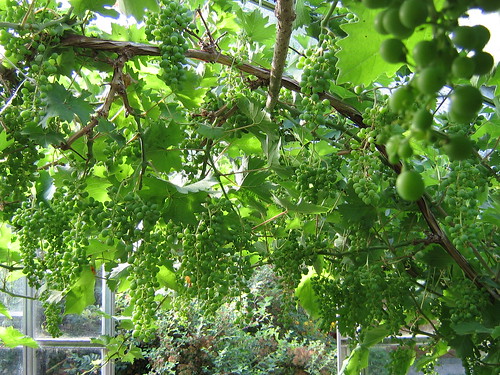
The greenhouse is the perfect place to grow a variety of fruit. In fact some fruit such as greenhouse grapes will positively thrive in the warmer environment under glass that mimics the Mediterranean conditions they are used to. But even less exotic fruit such as strawberries can be successfully grown under glass for an earlier crop.


Photo: Charlie Evatt

One of the most important considerations when growing fruit underglass is that almost all fruiting plants require pollinating. The very nature of a greenhouse can preclude access by pollinating insects and even if they can get in to collect pollen and nectar from your plants they may not be able to return to their base and convey the location of the plants that you want pollinating. If you are going to leave access points for insects be sure to allow escape routes too.

What do I need in my greenhouse?

That’s a quite a far-reaching question as it does depend on what you want to use your greenhouse for. But assuming you are a newbie to greenhouses and have your very first greenhouse to start growing, the first thing you need is good ventilation. Your greenhouse has a door, which needs to be close fitting and ideally wide enough to wheel a barrow through. It probably has a window or two that open manually, but to get the best airflow in your greenhouse you need vents that open low down and also vents up high to allow hot air to escape. You can buy automatic opening kits that fit onto greenhouse vents and will open the windows when the internal temperature rises, which is ideal if you work or are often away.

Growing Tomato
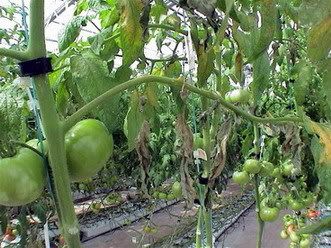
Photo: SuperFantastic

Many gardeners have one area of the greenhouse floor to plant into to for greenhouse tomatoes and other hothouse plants. On the other side they have a potting bench and some staging and shelves. Most greenhouse growers will admit that they never have enough room in their glasshouse to grow everything that they want to grow, so space management is important.

Greenhouse

A greenhouse (also called a glasshouse or hothouse) is a building where plants are cultivated.

Website Promotion Service
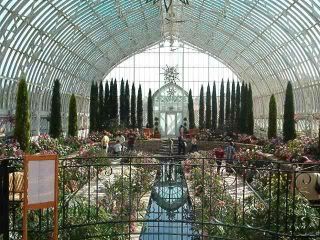
A greenhouse in Saint Paul, Minnesota.

A greenhouse is a structure with a glass or plastic roof and frequently glass or plastic walls; it heats up because incoming solar radiation from the sun warms plants, soil, and other things inside the building. Air warmed by the heat from hot interior surfaces is retained in the building by the roof and wall. These structures range in size from small sheds to very large buildings. The glass used for a greenhouse works as a selective transmission medium for different spectral frequencies, and its effect is to trap energy within the greenhouse, which heats both the plants and the ground inside it. This warms the air near the ground, and this air is prevented from rising and flowing away, in addition to the fact that infrared radiation cannot pass through the greenhouse glass. This can be demonstrated by opening a small window near the roof of a greenhouse: the temperature drops considerably. This principle is the basis of the autovent automatic cooling system. Greenhouses thus work by trapping electromagnetic radiation and preventing convection. Miniature greenhouses are known as a cold frame.

Controlled Environment Agriculture

Prior to 1970, the greenhouse vegetable industry was located near the high-population centers, mainly in the states of Ohio, Michigan, and Massachusetts. In 1867, a committee of the Massachusetts Horticultural Society noted the rapid growth of vegetables under glass and suggested that prizes be offered to encourage the practice (Massachusetts Horticultural Society, 1880). All commercial production was in soil.
In 1965, Ohio was the major greenhouse vegetable region in the United States, with more than 240 ha. After 1970, with the rapid rise in energy cost to heat greenhouses, along with the construction of superhighways to transport fresh produce from southern regions, Ohio became an importer of tomatoes. Today, the greenhouse vegetable industry in these eastern states has collapsed and is insignificant.
With the superhighways in America, the energy required to transport fresh vegetables from the southern region of the United States and from Mexico is less than that required to heat a greenhouse. For example, in conventional greenhouses in Ohio, nearly 40,000 kcal of energy are required to grow 1 kg of tomatoes vs. only 4000 kcal in the open field. Shipping 1 kg of tomatoes 5000 km north by semi-truck expends only 1865 kcal of energy.

Website Promotion Service

Along with the light factor are temperature considerations, especially in the southwest desert. For example, if tomatoes are selected as the crop to be grown year-round, low elevations must be avoided, due to the difficulty in maintaining desirable temperatures in the greenhouse during late spring and early fall, even with fan and pad cooling. In the late 1960s, hydroponic installations were installed in low-elevation regions in Texas and Arizona. In most regions of Texas, evaporative cooling is ineffective due to high ambient humidity. Escalating energy costs in the 1970s added to the costs of cooling in the summer, as well as heating during the winter months. This, coupled with insect and disease problems and high amortization costs, especially when growers were purchasing turnkey greenhouse systems rather than building their own growing system, caused most hydroponic installations to fail financially. This was true not only in Texas and Arizona, but throughout the United States.
Given the high cost of fan and pad equipment, future hydroponic growers will be selecting sites at specific elevations that have summer temperatures that do not require evaporative cooling, therefore sparing the costs of such cooling equipment. At the same time, an elevation should be selected that is not too high in order to avoid high heating costs in winter. In southern Arizona, such an elevation for tomato production would range from 1250 to 1675 m and for cucumber production, 600 to 1250 m.
Proposed as an alternative to fan and pad cooling is high-pressure fog systems. Recent experiences have proven this method of cooling desirable if the feed water is absolutely free of any undissolved or dissolved solids. It is important for the greenhouse structure to have ridge vents to accommodate ample air exchange for prescribed temperature and humidity control. Any time a grower deviates from the prescribed growing temperatures for a given crop, yields will be lowered. The more a grower has to cool or heat a greenhouse in order to maintain recommended temperatures, the greater the cost to operate the facility, therefore lessening financial return. If evaporative cooling systems are used, locating the greenhouse in a region of low outdoor humidity is important.

Website Promotion Service

Especially important is selection of a site free of insects that might be vectors for severe virus diseases. Early hydroponic ventures did not consider this. In the United States and Mexico, sites were selected where white flies existed. These can be a vector of gemini viruses, which are extremely lethal to most solanaceous and cucurbit crops. Screens on air intakes do not always work, as the white fly almost always gains entry into the growing area. Growing in regions where there are mild winters normally increases the incidence of insects and diseases due to the continued life cycle of the pest. Selecting a site that isn't already a major producer of vegetable crops is also advisable.
University of Arizona

Hydroponics Historical Review

The development of hydroponics has not been rapid. Although the first use of CEA was the growing of off-season cucumbers under "transparent stone" (mica) for the Roman Emperor Tiberius during the 1st century, the technology is believed to have been used little, if at all, for the following 1500 years.

Greenhouses (experimental hydroponics) appeared in France and England during the 17th century; Woodward grew mint plants without soil in England in the year 1699. The basic laboratory techniques of nutrient solution culture were developed (independently) by Sachs and Knap in Germany about 1860 (Hoagland and Arnon, 1938).

In the United States, interest began to develop in the possible use of complete nutrient solutions for large-scale crop production about 1925. Greenhouse soils had to be replaced at frequent intervals or else be maintained in good condition from year to year by adding large quantities of commercial fertilizers. As a result of these difficulties, research workers in certain U.S. agricultural experiment stations turned to nutrient solution culture methods as a means of replacing the natural soil system with either an aerated nutrient solution or an artificial soil composed of chemically inert aggregates moistened with nutrient solutions (Withrow and Withrow, 1948).

Between 1925 and 1935, extensive development took place in modifying the methods of the plant physiologists to large-scale crop production. Workers at the New Jersey Agricultural Experiment Station improved the sand culture method (Shive and Robbins, 1937). The water and sand culture methods were used for large-scale production by investigators at the California Agricultural Experiment Station (Hoagland and Arnon, 1938). Each of these two methods involved certain fundamental limitations for commercial crop production, which partially were overcome with the introduction of the subirrigation system initiated in 1934 at the New Jersey and Indiana Agricultural Experiment Stations (Withrow and Withrow, 1948). Gericke (1940) published a description of a quasi-commercial use of the liquid technique and apparently coined the word hydroponics in passing. The technology was used in a few limited applications on Pacific islands during World War II. After the war, Purdue Univ. popularized hydroponics (called nutriculture) in a classic series of extension service bulletins (Withrow and Withrow, 1948) describing the precise delivery of nutrient solution to plant roots in either liquid or aggregate systems. While there was commercial interest in the use of such systems, hydroponics or nutriculture was not widely accepted because of the high cost in construction of the concrete growing beds.

After a period of ~20 years, interest in hydroponics was renewed with the advent of plastics. Plastics were used not only in the glazing of greenhouses, but also in place of concrete in lining the growing beds. Plastics were also important in the introduction of drip irrigation. Numerous promotional schemes involving hydroponics became common with huge investments made in growing systems.

Greenhouse areas began to expand significantly in Europe and Asia during the 1950s and 1960s, and large hydroponic systems were developed in the deserts of California, Arizona, Abu Dhabi, and Iran about 1970 (Fontes, 1973; Jensen and Teran, 1971). In these desert locations, the advantages of the technology were augmented by the duration and interest of the solar radiation, which maximized photosynthetic production.

Unfortunately, escalating oil prices, starting in 1973, substantially increased the costs of CEA heating and cooling by one or two orders of magnitude. This, along with fewer chemicals registered for pest control, caused many bankruptcies and a decreasing interest in hydroponics, especially in the United States.

Since the inception of hydroponics, research to refine the methodology has continued. In the late 1960s researchers at the Glasshouse Crops Research Institute (GCRI), Littlehampton, England developed the nutrient film technique along with a number of subsequent refinements (Graves, 1983). This research gave rise to the hydroponic systems used today. Jensen and Collins (1985) published a complete review of hydroponics highlighting many new cultural systems developed in Europe and the United States.

Almost 20 years have passed since the last real commercial interest in hydroponics, but today there is renewed interest among growers establishing CEA/hydroponic systems. This is especially true in regions where there is concern about controlling pollution of ground water with nutrient wastes or soil sterilants. Today growers appear to be much more critical in regard to site selection, structures, the growing system, pest control, and markets.

from : University of Arizona

Share

Twitter Delicious Facebook Digg Stumbleupon Favorites More