For saving space and soil, this method also has several
other benefits, including no soil-borne diseases, no
weeds to pull and no soil to till, run-of-the-mill side
benefits of soil-less gardening.

Hydroponic Gardening Article

Hydroponics is basically a Greek word which associates the method of growing plants using nutrient solutions, without soil is known as hydroponics. Hydro means water and pono means labor.

Gardening

Does thinking of food laced with toxic pesticides and synthetic compounds kill your appetite? That's what industrial food production has brought to our tables - food that is hampering our health and creating havoc with the environment.

Gardening by Greenhouse

There are some plants that need extra heat, and the climate is just not right. For these occasions, greenhouse gardening is a great way to get what you need.

Flower Bulbs

Hydroponic is the technique of growing flowers, fruits or vegetables in a soilless environment. The practice originated from the Aztecs where they used rafts covered in soil from the lake bottom to plant vegetables

The Environmental

Apparently, we can see how nature is treated these days. It is a sad thing to know that people do not pay attention so much anymore to the environmental problems.

Showing posts with label Nutrient Solution. Show all posts

PREPARING THE NUTRIENT SOLUTION

For proper growth, plants must be supplied with nitrogen, phosphorus, potassium, calcium, magnesium, sulfur, iron, manganese, boron, zinc, copper, molybdenum, and chlorine. Within certain limits of composition and total concentrations, there can be a rather wide range in the nutrient solutions suitable for plant growth. Usually the small amount of minerals in the water supply can be ignored. When nutrients are deficient or present in excess in the solution, however, the plants will suffer. For this reason, you must be careful in selecting and adding the minerals that go into the nutrient solution.


Hydroponics Guide

Purity of the nutrient materials or chemicals is important in preparing a solution. In some cases, the fertilizer grade of a chemical may be used, and in other cases, a technical-grade or food-grade chemical may be needed. The best grades have few impurities; the lower or fertilizer grades may have more. Sometimes the plants may use the impurities. Because of the low price of the fertilizer-grade chemicals, they should be used whenever possible.

Many formulas have been devised for supplying the nutrient requirements for plant growth. Most of these recommendations will give satisfactory results, but they often require less than one gram of chemicals that are not easy to obtain.

Paint the storage vats and containers used for the nutrient solution to prevent exposure to light, and close the vats and containers to prevent contact with the air. Evaporation of the solution, whether through the atmosphere or through plants, reduces the amount of water and increases the proportion of salt in the solution. Too much salt may be detrimental to the plants.

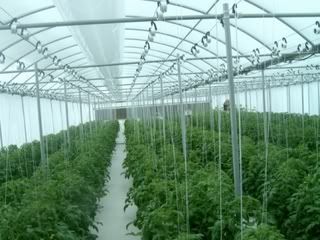
More Materials

Aeration is much easier in aggregate culture than in water-culture system. Draining and refilling the tank with nutrient solution causes air to move in and out of the aggregate material, thus supplying adequate oxygen to the roots.

Water Supply. Water requirements for this system are the same as those for the solution-culture methods. The mineral nutrients and the minerals present in the water as impurities accumulate in the aggregate materials as a result of evaporation. To overcome this accumulation of minerals, flood the aggregate material with water every two weeks. Drain off the water to wash out the minerals.

Applying Nutrient Solution. The "slop" or surface method is the simplest for adding the nutrient solution. In this method, the solution is poured over the aggregates by hand. A manual gravity-feed system with buckets or other vats and small growing containers may be used. The vat is attached to the bottom of the tank or container with a flexible hose, and is raised to flood the tank and lowered to drain it. The vat may be lowered and raised by hand or by means of a mechanical device. The vat should be covered to prevent evaporation and filled with new nutrient solution at least once every two weeks.


Hydroponics Guide

The gravity drip-feed system also works satisfactorily, and reduces the amount of labor. The vat is higher than the tank in this system, and the solution drips from the vat just fast enough to keep the aggregate moist.

A pump can be used to raise the solution to the desired depth for sub-irrigation. Sub-irrigation is a system of supplying the nutrients by raising and lowering the solution level from the bottom. The solution must be raised to a higher level for younger plants than for older plants. A timer may be arranged on the pumping system so that the nutrient solution can be added whenever necessary. If the pump is not a non-rusting pump, it should be washed carefully after each use to prevent rusting. This mechanical system for adding the nutrient solution is practical only for a large setup.

The nutrient material must be added and drained or raised and lowered in the tanks once or twice a day. When the weather is especially hot and dry, the aggregate material may need more than two drenchings. Examine the aggregate material frequently to be sure that it has not dried out around the roots. After a few examinations, you will know about when the nutrient solution should be added. Remember - frequent drenchings will cause little harm, and permanent injury may result if the plant roots dry out.

WHY ADD SILICON TO NUTRIENT SOLUTION?

Although silicon has not been recognized as an essential element for higher plants, its beneficial effects have been shown in many plants. Silicon is abundant in all field grown plants, but it is not present in most hydroponic solutions. Silicon has long been recognized as particularly important to rice growth, but a recent study indicated that it may only be important during pollination in rice (Ma et al. 1989). The beneficial effects of silicon (Si) are twofold:
  1. it protects against insect and disease attack (Cherif et al. 1994; Winslow, 1992; Samuels, 1991), and
  2. it protects against toxicity of metals (Vlamis and Williams, 1967; Baylis et al. 1994). For these reasons, I recommend adding silicon (about 0.1 mM) to nutrient solutions for all plants unless the added cost outweighs its advantages.

The Nutrient Solution

Modern nutrient solutions come in several different types. It is important to make sure that the solution you use is the best for your purpose. Solutions that are designed specifically for soil, often called plant "foods" or fertilizers, are suitable only for soil and not for hydroponics. One of the reasons for this is that various trace elements can be relied upon to exist in soil and they are not usually added to the solution. The other reason is that much cheaper and less soluble materials can be used with soil nutrients. They are also often crudely formulated and contain the wrong form of crucial elements such as nitrogen.


Website Promotion Service

True hydroponics nutrient solutions on the other hand must be complete, containing every element needed for plant growth in its most soluble form. This is why hydroponics solutions tend to be more expensive. Do not be put off by this as the total cost of nutrients is still a very small part of your overall expenditure and saving money on nutrients is to run the risk of serious problems. Always use the best quality nutrient solutions as the solution is the only source of nutrition in hydroponics so it must be of the highest quality. The advantage of course is that every time you water your hydroponics plant, you can be sure that it has a full profile of nutrients in exactly the right proportions. You can never be sure of this with plants in soil. In fact, it is almost impossible to maintain a good balance of nutrient with soil in containers.

While it is true that plant "foods" for soil are not suitable for hydroponics, it is quite possible to use hydroponics solutions for soil growing. You can actually achieve great improvements this way because the plant is fully supplied as it may not have been before. There is a risk, however, that you may overfeed the plant so we recommend that you make the solution at only half the regular strength and that you only use it once a week with soil. The symptoms of over feeding are easy to spot and quick to remedy.

Share

Twitter Delicious Facebook Digg Stumbleupon Favorites More