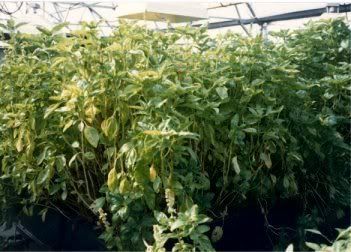
Clean air supplies oxygen which is an excellent purifier for plants and the aeroponic environment. It is required for all life including plants. For natural growth to occur the plant must have unrestricted access to air. Plants must be allowed to grow in natural manner for successful physiological development. The more confining the plant support becomes the greater incidence of increasing disease pressure of the plant and the aeroponic system.
Some researchers have used aeroponics to study the effects of root zone gas composition on plant performance. Soffer and Burger [Soffer et al., 1988] studied the effects of dissolved oxygen concentrations on the formation of adventitious roots in what they termed “aero-hydroponics.” They utilized a 3-tier hydro and aero system, in which three separate zones were formed within the root area. The ends of the roots were submerged in the nutrient reservoir, while the middle of the root section received nutrient mist and the upper portion was above the mist. Their results showed that dissolved O2 is essential to root formation, but went on to show that for the three O2 concentrations tested, the number of roots and root length were always greater in the central misted section than either the submersed section or the un-misted section. Even at the lowest concentration, the misted section rooted successfully.
Some researchers have used aeroponics to study the effects of root zone gas composition on plant performance. Soffer and Burger [Soffer et al., 1988] studied the effects of dissolved oxygen concentrations on the formation of adventitious roots in what they termed “aero-hydroponics.” They utilized a 3-tier hydro and aero system, in which three separate zones were formed within the root area. The ends of the roots were submerged in the nutrient reservoir, while the middle of the root section received nutrient mist and the upper portion was above the mist. Their results showed that dissolved O2 is essential to root formation, but went on to show that for the three O2 concentrations tested, the number of roots and root length were always greater in the central misted section than either the submersed section or the un-misted section. Even at the lowest concentration, the misted section rooted successfully.