Hello and Welcome to Hydroponics

Friday, December 29, 2006

Meeting Plant Needs

Like humans and animals, plants have very specific nutritional and environmental needs that must be met in order for the plant to grow and develop. Both humans and plans must consume a balanced diet and need protection from harsh environments.


Plants all over the world have adapted to specific environ-ments. A tomato plant, for instance, is a tropical plant andthrives in average daytime temperature of 80 F and night-time temperature of 60 F. When grown in temperaturesoutside these parameters a tomato plant may survive, butnot thrive and, if the temperatures are too extreme, the to-mato plant will die.Individual species of plants have very specific nutritionalneeds that must to be met. These needs may vary through-out the stages of the plant's growth.
For instance, a tomato plant needs more nitrogen during the vegetative growth stages and less nitrogen during the fruiting stages.As a compromise to various needs and stages of growth, hydroponic solutions can generally be modified to be suitable for the majority of plants. For best results, it is a good idea to plant crops with similar needs together so the compromise in minimal.In the soil, organic materials are broken down to release minerals and nutrients.


They can then be dissolved in water, taken up by the roots and passed through the stem into the leaves. In hydroponics we provide the minerals a plant needs in a water-soluble form, ready to be taken up by the plant roots. We are therefore able to provide a very exact diet for our plants in the most usable form.The more precisely a plant's needs are met, the more vigorous its growth will be. When you observe a lush, healthy plant, you can be sure that most or all of it's environmental and nutritional requirements are being met.

Monday, December 25, 2006

Flow Hydroponic System

Building a Simple Ebb and Flow Hydroponic System
A simple ebb and flow hydroponic system can be built with some basic components: a bucket, a tub, tubing and a growing medium. This lesson instructs you how to build an Ebb and Flow system. If you have already built the 11 Plant Garden or have your own store bought garden then you can proceed to Lesson Four.
The procedure outlined below for building a hydroponic unit can be applied to a classroom project or can be used by a student for building their own hydroponic garden at home.


You will need:

  • 1 bucket for your nutrient reservoir (2- 5 gallons)
  • 1 tub for your plant bed (approximately l' x 2' x 6")
  • 3 ft. plastic tubing, 1/2" diameter
  • enough Growing Medium to fill the tub (plant bed)
  • silicone or epoxy glue
  • drill with 1/2" bit
  • 2" x 2" piece of plastic screen or mesh
  • 1 rubber band
  • nutrient solution
  • seeds or bedding plants from your local nursery
  1. Drill a 1/2" hole on the side of the bucket, about 1" from the bottom
  2. Insert the hose into the hole in the bucket and seal the edges of the hole with the glue.
  3. Drill a 1/2" hole in the side of the tub (plant bed) about 1" from the bottom.
  4. Insert the other end of the tubing into the hole in the plant bed, allowing the end of the tubing to protrude 2" through the bucket. Seal the edges of the hole with the glue. Allow time for the glue to dry.
  5. Wrap the piece of screen around the end of the tubing that comes through the side of the plant bed and secure with the rubber band. This prevents the growing medium from clogging the tube.
  6. Pour the growing medium into the tub, filling it to I" below the rim. Your Ebb and Flow hydroponic garden is now ready for nutrient solution and planting.
  7. Fill your bucket with the mixed nutrient solution. Lift the bucket (higher than the grow bed) and allow the solution to run from the bucket into the grow bed. You can place the bucket on something higher than the grow bed white waiting for the nutrient solution to drain into the grow bed. When the growing medium is saturated, lower the bucket so the solution can drain back into the bucket.
  8. Once your growing medium is saturated, you can plant your seeds. Follow the instructions on the seed packet for planting depth. Or use starter plants from your local nursery. Carefully wash the lose medium from the bedding plant roots before putting the plants in the plant bed.
  9. Once you have planted the seeds, the growing medium will need to be kept moist with nutrient solution. This is done by raising the bucket (flooding the grow bed) and lowering the bucket (draining the grow bed). This should be done several times a day to maintain a proper moisture level in the growing medium surrounding the plant roots.


You can automate this hydroponic garden by adding a small pump in your nutrient reservoir to flood the grow bed and a timer to start and stop the pump.

Saturday, December 23, 2006

Hydroponics Systems Basic Requirements

Light
Let there be Light! Light is the first line of life for all matter, plants are no exception. Light is essential to carry on photosynthesis, without which you could give your plants all the nutrients and moisture money could buy, but you'd still end up with a dead heap of vegetable mass. Sunlight is the ideal source of light and contains the Reds and Blues plants require to produce a healthy growth. However in a Hydroponic system Sunlight is not always an option. Artificial Horticultural lights provide the solution for the hydroponic gardener, they are cost effective assuming you shop carefully.


Oxygen -Nutrient Ratio
Plants can't absorb their nutrients unless Oxygen is present the higher the Oxygen level the quicker the absorption of nutrients . Oxygen maintains a healthy root system and allows the plant to absorb nutrients. Without oxygen circulating around the root system root rot would quickly develop. Man does not live by bread alone, and plants do not live by water alone, ample oxygen must be in the water. it. You do not grow in water in a hydroponic system, the water is a medium through which Nutrients and oxygen are fed to the roots, you need only keep the roots moist - not soaked.


Nutrient Strength
Nutrients must be solely designed for Hydroponics. Soil fertilizers utilize bacteria to break down more complex elements into useful ones- a ideal hydroponic system has minimal bacteria, if any ,Soil fertilizers are less soluble- Hydroponic systems require solubility as the nutrient delivery system is based upon that factor., Soil fertilizers are generally not pH adjusted, and usually too slow to release the necessary elements to be suitable for Hydroponic Systems.


Growth Mediums
In hydroponic's, the growing medium, not soil, holds moisture and anchors roots . Composed of inert mineral matter, it won't decompose or harbor potential soil-born problems. All the plant's nutritional requirements are filled by the nutrient mixes you add to your garden reservoir. There are two basic growth mediums recommended for Hydroponic Gardeners, Horticultural Rockwool and Geolite Aggregate, I generally use Horticultural Rockwool, as I find it more cost effective.


pH - Alkalinity & Acidity
pH is the level of acidity or alkalinity of the nutrient solution. Most nutrients in common tap water will be within the range of 6 to 6.5 pH. Which is suitable for Hydroponics systems. The requirements of Soil ph is not the requirements of Hydroponics ph .. do not confuse the two.


Temperature
Temperature requirements for plants in a hydroponics system are the same as out of a Hydroponic system.


Air
Plants require Carbon Dioxide, it is what they breathe. Poor ventilation will kill plants as surely as a lack of sunlight or water will. Ventilation systems as well as Carbon Dioxide Enrichment and control Systems are affordable and available. And are recommended for a lush Hydroponics Garden.


Water Quality
In most situations tap water is just fine for hydroponics systems, over extended periods of time you may get some mineral build-up, but this s not a major cause for concern. Excessive salinity or high zinc content could be harmful to your Hydroponics Garden , but generally as a rule of Thumb - if you drink the water yourself it's just fine.


from-http://www.geocities.com/green_cache/hydroponics.html

Wednesday, December 20, 2006

Disadvantages - Misconceptions

Hydroponics has been exaggerated as miraculous. There are many widely held misconceptions regarding hydroponics, and the following facts should be noted:


  • Hydroponics will not always produce greater crop yields than with good quality soil.
  • Hydroponic plants cannot always be spaced closer together than soil-grown crops under the same environmental conditions.
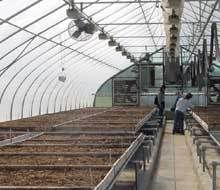
  • Hydroponics usually requires more expensive equipment than geoponics. Most hydroponic crops are grown in greenhouses or controlled environment agriculture.
    Hydroponics usually requires more frequent maintenance than geoponics. If timers or electric pumps fail or the system clogs or springs a leak, plants can die very quickly in many kinds of hydroponic systems.
  • Hydroponic produce will not necessarily be more nutritious or delicious than soil-grown produce.
  • Hydroponics usually requires a greater technical knowledge than crop growth in soil (geoponics).
  • For the previous three reasons, hydroponic crops are usually more expensive than soil-grown crops.
  • Solution culture hydroponics requires that the plants be supported because the roots have no anchorage without a solid medium.

Sunday, December 17, 2006

Advantages of Hydroponic Growing

There are many advantages of hydroponic growing. These include

Photobucket - Video and Image Hosting


  • In studies it has been proven that hydroponic produce is higher in nutritional value than field grown crops.
  • By eliminating the soil in a garden, you eliminate all soil borne diseaseA hydroponic garden uses a fraction of the water that a soil garden does because no water is wasted or consumed by weeds.
  • Most hobby hydroponic gardens are less work than soil gardens because you do not have soil to till or weeds to pull.
  • By providing the exact nutrients your plants need, they will grow more rapidly and produce bigger yields.
  • In hydroponics, plant spacing can be intensive, allowing you to grow more plants in a given space than soil grown produce.
  • A small hydroponic garden can be set up almost anywhere.
    Hydroponic produce generally tastes better than field-grown produce.
  • If you are growing indoors or in a greenhouse, you can grow your hydroponic plants on a year-round basis.

- hydroponicsonline.com

Friday, December 15, 2006

Hydroponics Techniques

The two main types of hydroponics are solution culture and medium culture. Solution culture does not use a solid medium for the roots, just the nutrient solution. The three main types of solution culture are static solution culture, continuous flow solution culture and aeroponics. The medium culture method has a solid medium for the roots and is named for the type of medium, e.g. sand culture, gravel culture or rockwool culture. There are two main variations for each medium, subirrigation and top irrigation. For all techniques, most hydroponic reservoirs are now built of plastic but other materials have been used including concrete, glass, metal and wood. The containers should exclude light to prevent algae growth in the nutrient solution.

Static solution culture
In static solution culture, plants are grown in containers of nutrient solution, such as glass Mason jars, plastic buckets, tubs or tanks. The solution is usually gently aerated but may be unaerated. If unaerated, the solution level is kept low enough that enough roots are above the solution so they get adequate oxygen. A hole is cut in the lid of the reservoir for each plant. There can be one to many plants per reservoir. Reservoir size can be increased as plant size increases. A homemade system can be constructed from plastic food containers or glass canning jars with aeration provided by an aquarium pump, aquarium airline tubing and aquarium valves. Clear containers are covered with aluminum foil, butcher paper, black plastic or other material to exclude light. The nutrient solution is either changed on a schedule, such as once per week, or when the concentration drops below a certain level as determined with as electrical conductivity meter. Whenever the solution is depleted below a certain level, either water or fresh nutrient solution is added. A Mariotte's bottle can be used to automatically maintain the solution level. In raft solution culture, plants are placed in a sheet of buoyant plastic that is floated on the surface of the nutrient solution. That way, the solution level never drops below the roots.

Continuous flow solution culture
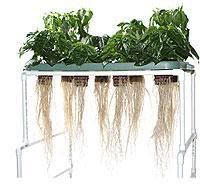
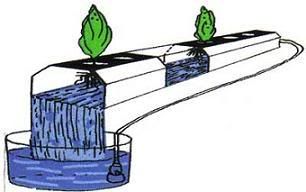
In continuous flow solution culture the nutrient solution constantly flows past the roots. It is much easier to automate than static solution culture because sampling and adjustments to pH and nutrient concentrations can be made in a large storage tank that serves potentially thousands of plants. A popular variation is the nutrient film technique or NFT. In NFT, the plants grow through light-proof plastic films placed over shallow, gently sloping channels. A steady flow of nutrient solution is maintained along the channel, and the roots grow into dense mats, with a thin film of nutrient passing over them (hence the name of the technique). A downside of NFT is that it has very little buffering against interruptions in the flow e.g. power outages, but overall, it is probably one of the more productive techniques.

Photobucket - Video and Image Hosting


Aeroponics
In aeroponics, the roots of a plant are suspended in a darkened chamber and periodically covered with a mist or fog of nutrient solution. No solid medium is used. Traditional aeroponic techniques use pumps and misters more commonly found in micro-irrigation systems, whereas state-of-the-art techniques employ ultrasonic nebulizers which render the nutrient solution into an extremely fine fog.

Ultrasonic foggers mainly consist of piezioelectric disks used to vibrate water in a hydroponic reservoir at ultra high frequencies. This process turns the water and nutrients into droplets 5-15 micron in size. This allows for better nutrient uptake, with the addition of exponentially high oxygen ratios over the already established efficiency of aeroponics. Often ultrasonic foggers are placed in floats and allowed to produce a thick cloud of fog around the base of the plants root structure suspended within the reservoir.

The Land Exhibit at EPCOT Center has aeroponics in vertical sections of large-diameter plastic pipe. Plants are placed through holes drilled in the side of the pipe so roots are inside. The pipe sections are suspended from the greenhouse ceiling and move continuously around the greenhouse on a motorized system. Periodically they pause under a mist nozzle to be irrigated. Aeroponics may be the best method for plants with thick roots such as trees. Thick roots may not get adequate aeration in static or flowing systems.

Passive subirrigation
The medium generally has large air spaces, allowing ample oxygen to the roots, while capillary action delivers water and nutrients to the roots from the base of the medium. The simplest method has the container constantly sit in a shallow layer of nutrient solution or on a capillary mat saturated with nutrient solution. A variety of materials can be used for the medium: vermiculite, perlite, clay granules, rockwool, gravel or Oasis Horticubes. This method requires little maintenance, requiring only occasional refilling and replacement of the nutrient solution. This keeps the medium regularly flushed with nutrient solution and air.

It is important in passive subirrigation to wash out the system from time to time to remove salt accumulation. This may be checked with an electrical conductivity or ppm meter, a good average reading would be about 1500 ppm. Lettuce grows well at about 800 ppm and tomatoes to 3000 ppm but both will grow reasonably well on 1500 ppm. It is important to keep the pH reading at about 6.3 to enable nutrient uptake. Data are available for the optimum settings for most plants.

This is commonly employed for large display plants in public buildings: in Europe a system using small clay granules is marketed for growing houseplants. One method for home use is called semi-hydroponic for growing orchids. A similar subirrigation method, uses a wick. The wick runs from the base of the plant container (e.g. a pot or a tray) down to a bottle of nutrient solution. The solution travels up the wick into the medium through capillary action.

Photobucket - Video and Image Hosting


Flood and drain (or ebb and flow system) subirrigation
In its simplest form, there is a tray above a reservoir of nutrient solution. The tray is either filled with growing medium (clay granules being the most common) and planted directly, or pots of medium stand in the tray. At regular intervals, a simple timer causes a pump to fill the upper tray with nutrient solution, after which the solution drains back down into the reservoir. This keeps the medium regularly flushed with nutrients and air.

Top irrigation
In top irrigation, nutrient solution is periodically applied to the medium surface. This may be done manually once per day in large containers of some media, such as sand. Usually, it is automated with a pump, timer and drip irrigation tubing to deliver nutrient solution as frequently as 5 to 10 minutes every hour.

Deep Water Culture (DWC)
Deep Water CultureThe hydroponic method of plant production by means of suspending the plant roots in a solution of nutrient rich, oxygenated water. Traditional methods favour the use of plastic buckets with the plant contained in a net pot suspended from the centre of the lid and the roots suspended in the nutrient solution.

Wednesday, December 13, 2006

The Newly Popular Ancient Growing System

Hydroponics is usually regarded as either a product of the 20th century or a product of ancient civilizations. So which is true? Neither, actually. There is evidence that both the Aztecs and the Babylonians may have used hydroponic growing systems, but there is no evidence that either of these systems was culturally-borrowed or passed on to successive generations. Rather, it appears that knowledge of the hydroponics system faded away until it was rediscovered in the early 1900s by scientists looking to make farming more efficient.

Today, creating a hydroponics growing system entails implementing a high degree of controllability - using hydroponics gardening, hydroponics light, and hydroponics equipment, rather than natural systems, which are eminently harder to control.


Hydroponic gardening today usually requires that a farmer purchase wholesale hydroponics nutrients and hydroponics equipment - and then assemble them in a system with a considerable amount of moving parts in a "hydroponics green house." Some systems will include large trays with spongy material to soak up water. Seeds will then be placed on the sponge, prompting the roots to move through a hole in the sponge to soak up the water.

While hydroponics cannot gain as high returns to scale as traditional tractor farming, since harvesting can't feasibly be done mechanically - and since growing requires massive structures and electrical inputs - hydroponics farmers can still reduce costs by purchasing discount hydroponics products in bulk. They can get at least some increased returns to scale, as the price of all building materials (as well as electricity use) is generally decreased for larger purchases.
Although hydroponic growing was created by the ancients, the science driving better techniques is still in its infancy when compared to large-scale outdoor farming techniques. Perhaps better technology and cheaper inputs will further reduce hydroponic growing in the future.

- Michalis "BIG Mike" Kotzakolios

Saturday, December 09, 2006

Hydroponics

Ever heard of soil-less gardening? Another name for it is hydroponics. It’s the latest development in agriculture - a solution, they said, to the problem of gardening in small spaces.

“Hydroponics is soil-less gardening. It means more food in less space with less water in less time,” explains Dan Lubkeman, president of the Hydroponic Society of America, an organization that has helped hobbyists and commercial growers from 23 countries on five continents since 1979.

“It’s like playing Mother Nature indoors. You provide the sun, food, water, and fresh water,” he adds.

You immediately know that you are eating a product of hydroponics as soon as you chump on a carrot. Just from the crunch of it, or the moistness of the lettuce, the meatiness of a beefsteak tomato, and the overall clean, fresh flavor that explodes in your palate like delicious edible fireworks…. It’s hydroponics through and through.

Hydroponics can be used on any produce and plants. What grows using the traditional methods also grows in a hydroponics system. Aside from saving space and soil, this method also has several other benefits, including no soil-borne diseases, no weeds to pull and no soil to till. These are just your regular, run-of-the-mill side benefits of soil-less gardening.

“Also, the plants can be grown close together, which means it’s easy to grow salad makings in your kitchen,” adds Neil Watson, a spokesperson for General Hydroponics, which manufactures and sells hydroponic products in Sebastopol, California.

For those who live in condominiums or in residences with little yard space, that’s great news. Now, you can grow tomatoes, peppers, and strawberries right in your own home. But you should not that hydroponics itself is a complicated method. In fact, it is composed of more than one method.

Some methods of hydroponics do away with soil. Others use only a little material as a means of physical support. Whatever method you choose, you should know as early as now that growing plants hydroponically may involve more than the usual matter of trial and error.


Below are some common types of hydroponics currently used by home gardeners and farmers worldwide:

Passive Hydroponics
This is considered by many as the simplest approach, mainly because it requires the least maintenance. All you, as a grower, need is a container filled with a medium. Place the container in a tray of nutrient solution. Occasionally, the solution may need to be replaced.

Flood and Drain
This is another name for “ebb and flow” hydroponics. Place pots made of a medium in a tray above a reservoir of nutrient solution. To replenish the nutrients in the tray, all you need is a pump set on a timer. This will keep the pot regularly flushed with food and air.

“This might be the most popular, most practical and cleanest method available,” Watson says.

Deep Water Culture
In this method of hydroponics, the roots of your plants are suspended from above and allowed to hang into an aerated nutrient solution. As an aid to aeration, you can use standard aquarium pumps, air stones, or any device that produce bubbles. Aeration help deliver oxygen to the roots.

Watch out for algae formation. To prevent them from forming in the container, choose a plant container that is light-proof.


Order Flowers Online

Hydroponic

It’s all about marketing. That’s what local growers say about hydroponic gardening. In a time when water and fertile lands to farm are scarce, hydroponic or soilless gardening is considered as a some kind of mana form heaven. Where before farmers where completely at the mercy of the seasons, now they can grow crops throughout the year and yield good harvests no matter the season. That is most direct effect of hydroponics. The possibility that plants could survive and grow without soil as the nutrient source was first described historically by Woodward in 1699, though the technique has been in practice since the time of the Hanging Gardens of Babylon.
However, it was only in the 1840s when the principle was applied in modern agriculture. Researchers discovered that by developing a formula containing all the essential nutrients that plants need for growth – nitrogen, phosphorous, potassium, carbon dioxide, and hydrogen dioxide (H20) – the need for soil in growing them may be completely eliminated. Adopting this idea, a number of German botanists soon developed the basic nutrient formulas and growing techniques which are in use today. With hydroponic gardening, the growing of crops requires as little as 10% as much land as regular farming, and less than 10% as much water. And sometimes, the water used may be even dramatically lessened further if the water is recirculated.


One key advantage of hydroponic gardening is that the produce is less affected by insects thriving in soil or diseases caused by soil microorganisms. This, of course, means that farmers are less inclined to use insecticide to keep these pests away. The overall result therefore is that you have yourself crops that do not carry traces of insecticide, and can be picked ripe just before eating so preservatives are not required. Produce such as broccoli, cabbage, celery, chard, cucumbers, eggplant, flowers, grapes, lettuce, melons, onions, peppers, pole beans, radishes, strawberries, and tomatoes have been grown hydroponically.Another attractive feature of hydroponic gardening is water economy. In arid areas, where precious water must be re-circulated, hydroponic systems may help improve harvest yields. A large volume of hydroponic food can be grown rapidly in a small area. In fact, it has been reported that four heads of lettuce can be raised in the same amount of space required to grown one head of field lettuce. There are various techniques to hydroponic gardening. In water culture, the roots of the plants are held in a large waterproof tank.

The plants are supported by mesh or string, and they get their food from the nutrient formula contained in the tank.Another form of hydroponics is gravel culture. Considered a more costly system to install and maintain, gravel culture involves a waterproof bench which is filled with inert pea-sized gravel. These are used to support the roots f the plants. Then, a solution containing all the essential nutrients required by the plant is pumped into the gravel from a holding tank. When the bench is full of the solution, the pump is turned off and the solution drains back to the holding tank.The solutions for both systems are replenished periodically. And for lighting, a number of grow light devices are available used to automate lighting for plants.

Hydroponics News


Free Blogger Templates by Isnaini Dot Com. Powered by Blogger