Lo-pressure Units
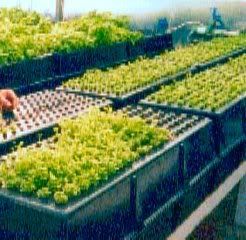
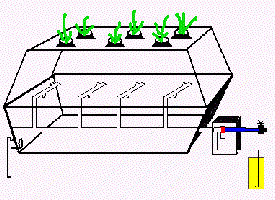
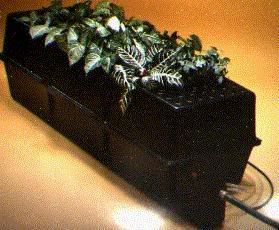
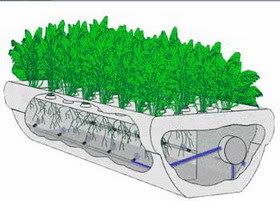
In most lo-pressure aeroponic gardens, the plant roots are suspended above a reservoir of nutrient solution or inside a channel connected to a reservoir. A low-pressure pump delivers nutrient solution via sprayer nozzles or by ultrasonic transducers, which then drips or drains back into the reservoir. As plants grow to maturity in these units they tend to suffer from dry sections of the root systems, which prevent adequate nutrient uptake. These units, because of cost, lack features to purify the nutrient solution, adequately remove debris, mold, and pathogens. Such units are usually suitable for bench top growing and demonstrating the principles of aeroponics.
Wednesday, February 28, 2007
Types of Aeroponics : Lo-pressure Units
Labels: demonstrating the principles of aeroponics, Lo-pressure Units, Types of Aeroponics
Posted by Thanate 0 comments Links to this post
Tuesday, February 27, 2007
Terminology
- Aeroponic growing refers to plants grown in an air culture can develop and grow in a normal and natural manner.
- Aeroponic growth refers to growth achieved in an air culture.
- Aeroponic system refers to hardware and system components assembled to sustain plants in an air culture.
- Aeroponic greenhouse refers to a climate controlled glass or plastic structure comprised of equipment to grow plants in air/mist environment.
- Aeroponic conditions refers to air culture environmental parameters for sustaining plant growth for a plant specie.
- Aeroponic roots refers to a root system grown in an air culture.
Labels: natural manner, Terminology
Posted by Thanate 0 comments Links to this post
Sunday, February 25, 2007
Nutrient Uptake
The discrete nature of interval and duration aeroponics allows the measurement of nutrient uptake over time under varying conditions. Barak et al. used an aeroponic system for non-destructive measurement of water and ion uptake rates for cranberries (Barak, Smith et al. 1996).
Close-up of roots grown from wheat seed using aeroponics, 1998
In their study, these researchers found that by measuring the concentrations and volumes of input and efflux solutions, they could accurately calculate the nutrient uptake rate (which was verified by comparing the results with N-isotope measurements). After verification of their analytical method, Barak et al. went on to generate additional data specific to the cranberry, such as diurnal variation in nutrient uptake, correlation between ammonium uptake and proton efflux, and the relationship between ion concentration and uptake. Work such as this not only shows the promise of aeroponics as a research tool for nutrient uptake, and also opens up possibilities for monitoring of plant health and optimization of crops grown in closed environments.
Labels: ammonium uptake, Nutrient Uptake, proton efflux
Posted by Thanate 1 comments Links to this post
Saturday, February 24, 2007
Advanced Materials
NASA funded research and development of new advanced materials to improve aeroponic reliability and maintenance reduction. It also has determined that high pressure hydro-atomized mist of 5- 50 microns micro-droplets is necessary for long-term aeroponic growing.For long-term growing, the mist system must have significant pressure to force the mist into the dense root system(s).
Repeatability is the key to aeroponics and includes the hydro-atomized droplet size. Degradation of the spray due to mineralization of mist heads inhibits the delivery of the water nutrient solution, leading to an environmental imbalance in the air culture environment.Special low-mass polymer materials were developed are used to eliminate mineralization in next generation hydro-atomizing misting and spray jets.
Labels: Advanced Materials, environmental imbalance, hydro-atomizing
Posted by Thanate 0 comments Links to this post
Friday, February 23, 2007
Mineralization
Mineralization of the ultra-sonic traducers requires maintenance and potential for component failure. This is also a shortcoming of metal spray jets and misters. Restricted access to the water causes the plant to loose turgidity and wilt.
Labels: Mineralization
Posted by Thanate 0 comments Links to this post
Thursday, February 22, 2007
Water/Nutrient Hydro-atomization
Aeroponic equipment involves the use of sprayers, misters, foggers, or other devices to create a fine mist of solution to deliver nutrients to plant roots. Aeroponic systems are normally closed-looped systems providing macro and micro-environments suitable to sustain a reliable constant air culture. Numerous inventions have been developed to facilitate aeroponic spraying and misting.
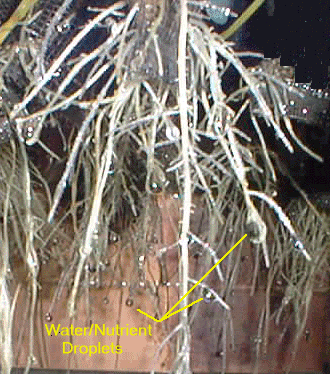
Aeroponic hydro-atomized water/nutrient spray, 1996
The key to root development in an aeroponic environment is the size of the water droplet. In commercial applications, a hydro-atomizing spray is employed to cover large areas of roots utilizing air pressure misting.
A variation of the mist technique employs the use of ultrasonic nebulizers or foggers to mist nutrient solutions in low-pressure aeroponic devices.
Water droplet size is crucial for sustaining aeroponic growth. Too large of a water droplet means less oxygen is available to the root system. Too fine of a water droplet such as those generated by the ultra-sonic mister produce excessive root hair without developing a lateral root system for sustained growth in an aeroponic system.
Labels: aeroponic environment, Hydro-atomization, Water/Nutrient
Posted by Thanate 0 comments Links to this post
Wednesday, February 21, 2007
Natural Disease-free Cultivation
Aeroponics can limit disease transmission since plant-to-plant contact is reduced and each spray pulse can be sterile. In the case of soil, aggregate, or other media, disease can spread throughout the growth media, infecting many plants. In most greenhouses these solid media require sterilization after each crop and, in many cases, they are simply discarded and replaced with fresh, certified sterile media.
A distinct advantage of aeroponic technology is that if a particular plant does become diseased, it can be quickly removed from the plant support structure without disrupting or infecting the other plants.
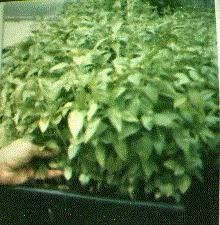
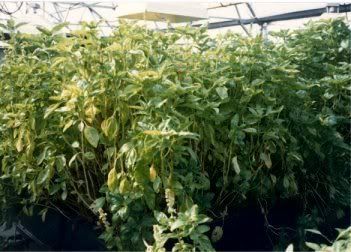
Basil grown from seed in an aeroponic system located inside a modern greenhouse was first achieved 1986
Due to the disease-free environment that is unique to aeroponics many plants can grow at higher density (plants per sq meter) when compared to more traditional forms of cultivation (hydroponics, soil and NFT). Commercial aeroponic systems incorporate hardware features that accommodate the crops expanding root systems.
Researcher du Toit, L.J., H.W. Kirby and W.L. Pedersen (1997). “Evaluation of an Aeroponics System to Screen Maize Genotypes for Resistance to Fusarium graminearum Seedling Blight.” These researchers describe aeroponics as "valuable, simple, and rapid method for preliminary screening of genotypes for resistance to specific seedling blight or root rot.”
The isolating nature of the aeroponic system allowed them to avoid the complications encountered when studying these infections in soil culture.
Labels: aeroponic technology, Basil grown, Natural Disease-free Cultivation, Seedling Blight, soil and NFT
Posted by Thanate 0 comments Links to this post
Tuesday, February 20, 2007
Benefits of Air (oxygen)
Clean air supplies oxygen which is an excellent purifier for plants and the aeroponic environment. It is required for all life including plants. For natural growth to occur the plant must have unrestricted access to air. Plants must be allowed to grow in natural manner for successful physiological development. The more confining the plant support becomes the greater incidence of increasing disease pressure of the plant and the aeroponic system.
Some researchers have used aeroponics to study the effects of root zone gas composition on plant performance. Soffer and Burger [Soffer et al., 1988] studied the effects of dissolved oxygen concentrations on the formation of adventitious roots in what they termed “aero-hydroponics.” They utilized a 3-tier hydro and aero system, in which three separate zones were formed within the root area. The ends of the roots were submerged in the nutrient reservoir, while the middle of the root section received nutrient mist and the upper portion was above the mist. Their results showed that dissolved O2 is essential to root formation, but went on to show that for the three O2 concentrations tested, the number of roots and root length were always greater in the central misted section than either the submersed section or the un-misted section. Even at the lowest concentration, the misted section rooted successfully.
Labels: Benefits of Air, lowest concentration, oxygen to plant roots
Posted by Thanate 0 comments Links to this post
Monday, February 19, 2007
True Aeroponics
Air cultures optimize access to air for successful plant growth. Materials and devices which hold and support the aeroponic grown plants must be devoid of disease and pathogens as well. A distinction of a true aeroponic culture and apparatus is that it provides plant support features that are monomial. Monomial contact between a plant and support structure allows for 100% of the plant to be entirely in air. Long-term aeroponic cultivation requires the root systems to be free of constraints surrounding the stem and root systems. Physical contact is minimized so that it does not hinder natural growth and root expansion, access to pure water, air exchange and disease-free conditions.
Close-up of the first patented aeroponic plant support structure. It's unrestricted support of the plant allows for normal growth in the air/moist environment - still in use today
Labels: True Aeroponics
Posted by Thanate 0 comments Links to this post
Sunday, February 18, 2007
Aeroponic Seed Germination
By 1985, GTi introduced second generation aeroponics hardware, known by as the 'Genesis Growing System'.
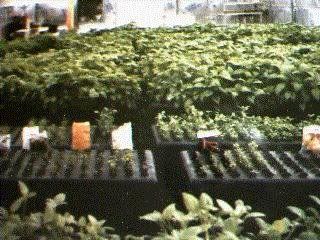
GTi's Aeroponic Growing System greenhouse facility, achieved 1985
This second generation aeroponic apparatus was a closed-looped system. It utilized recycled effluent precisely controlled by a microprocessor. Aeroponic graduated to the capability of supporting seed germination, thus making GTi's the world's first plant and harvest aeroponic system.
Many of these open-loop unit and closed-loop aeroponic systems are still in operation today.
In a true aeroponic apparatus, the plant is totally suspended in air, giving the plant access to 100% of the available oxygen in the air. This maximizes the level of oxygen surrounding the stem and root system, accelerating and promoting root growth within the plant. While there is a constant available source of oxygen, the intermittent hydro-atomizing of a spray/mist of the water-nutrient solution provides the necessary moisture and essential minerals to keep plants turgid and alive.
Labels: Aeroponic Growing System, Aeroponic Seed Germination
Posted by Thanate 0 comments Links to this post
Saturday, February 17, 2007
Air-rooted Transplants
Aeroponics time-warped tissue culture technology. It cloned plants in less time and reduced numerous labor steps associated with tissue culture techniques. Aeroponics could eliminate stage I and stage II plantings into soil (the bane of all tissue culture growers).
Cloned aeroponics transplanted directly into soil – its air roots made it all possible (1983).
Tissue culture plants must be planted in a sterile media (stage-I) and expanded out for eventual transfer into sterile soil (stage-II). After they're strong enough they are transplanted directly to field soil. Besides being labor intensive the entire process of tissue culture is prone to disease, infection, and failure.With the Genesis Machine growers cloned and transplanted air-rooted plants directly into field soil. Aeroponic roots were not susceptible to wilting and leaf loss or loss due to transplant shock (something hydroponics can never overcome). Because of their healthiness, air-rooted plants were less likely to be infected with pathogens.The efforts by GTi ushered in a new era of artificial life support for plants capable of growing naturally without the use of soil or hydroponics. GTi received a patent for an all- plastic aeroponic method and apparatus, controlled by a microprocessor in 1985.Aeroponics became known as a time and cost saver. The economic factors of aeroponic’s contributions to agriculture were taking shape.
Labels: aeroponic method and apparatus, Aeroponic roots, Air-rooted Transplants, controlled by a microprocessor
Posted by Thanate 0 comments Links to this post
Friday, February 16, 2007
Aeroponic Propagation (Cloning)
For the first time in agricultural history, greenhouse growers could propagate and grow inside a self-contained aeroponic system.
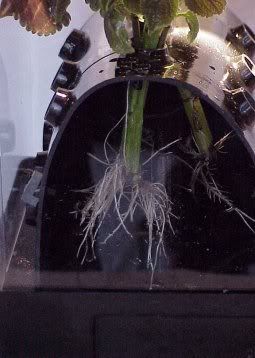
GTi's apparatus cut-away of vegetative cutting propagated aeroponically, achieved 1983
Numerous plant species could now be started by vegetative cuttings. It gave growers an opportunity to clone all types of plants, trees, shrubs, cacti, and ground covers from a simple stem cutting.
Suddenly aeroponics surpassed hydroponics and tissue culture as means for sterile propagation of plant species. With the Genesis Machine any grower could clone plants, plants that were traditionally considered hard to root. Plants could be cloned and grown using aeroponics by the hundreds or even thousands. Cloning became easy because the aeroponic apparatus initiated faster and cleaner root development. And it cloned them fast, according to Colorado State University (Hughes, 1983).
Labels: Aeroponic Propagation, GTi's apparatus
Posted by Thanate 0 comments Links to this post
Wednesday, February 14, 2007
How Aeroponics Works

Animation of the world's first commercially available avaaeroponic apparatus 1983 - it was powered by tap water and a microchip
Labels: How Aeroponics Works
Posted by Thanate 0 comments Links to this post
Tuesday, February 13, 2007
Aeroponics Apparatus
The first commercially available aeroponic apparatus was manufactured and marketed by GTi in 1983. Known then, as the Genesis Machine - taken from the first Star-Trek movie. The Genesis Machine it was marketed as the 'Genesis Rooting System'.
GTi's device incorporated an open-loop water driven apparatus, controlled by a microchip, and delivered a hi-psi hydro-atomized nutrient spray inside an aeroponic chamber.
At the time, the achievement was revolutionary. In terms of a developing (artificial air culture) technology - the Genesis Machine - that simply connected to a water faucet and an electrical outlet actually grow plants in air - and fast too!
Labels: Aeroponics Apparatus, Genesis Machine
Posted by Thanate 0 comments Links to this post
Monday, February 12, 2007
Ecological Advantages
Aeroponic growing is considered to be safe and ecologically friendly for producing natural healthy plants and crops. The main ecology advantages of aeroponics are water and energy conservation. When compared to hydroponics, aeroponics offers lower water and energy inputs per sq meter of growing area.
Labels: Ecological Advantages
Posted by Thanate 0 comments Links to this post
Sunday, February 11, 2007
Aeroponics Methods
Aeroponics refers to the methods and apparatus used to cultivate, grow, and sustain plant and crop growth in an air culture. Many types of plants can be grown in air by using true aeroponic methodsTo grow aeroponically refers to the necessary processes needed to achieve a sustainable aeroponic growth.
Aeroponics is not to be confused with either the hydroponic or geoponic technique. Aeroponic plant growth is sustained by the intermittent spray of a hydro-atomized nutrient solution as it remains suspended in air.In a true hydroponic apparatus, the plant's root system is totally submerged in water ('hydro'); while growing geoponically requires the plant to naturally root itself in soil/ground ('geo').In an aeroponic system, however, the plant is suspended into an enclosed air environment where the lower portion stem and roots protrude into a hydro-atomized nutrient solution and environment. The leaves and crown of the plant extended above into air. The root and crown of the plant are separated by the plant support structure. The lowest stem portion and root system are sprayed/misted for short durations with a hydro-atomized pure water/nutrient solution.
Labels: Aeroponics Methods, hydro-atomized, sprayed/misted
Posted by Thanate 0 comments Links to this post
Saturday, February 10, 2007
Basic Principles of Aeroponics
The basic principle of aeroponic growing is to allow plants to grow under pesticide-free and disease-free conditions, growing in a natural healthy manner; where the aeroponic environmental mimics nature's environmental conditions, which advances plant development, health, growth, flowering and fruiting for any given plant species and cultivars.
Labels: Basic Principles of Aeroponics
Posted by Thanate 0 comments Links to this post
Friday, February 09, 2007
Hydroponics (water culture)
Hydroponics (water culture) uses lots of water and essential minerals to sustain plant growth. Hydroponic growing requires the roots to be submerged in water or water soaked aggregate, with air bubbled into the mix. While in-vitro (meaning under glass) tissue culture utilizes an agar media to supply the necessary essentials to sustain cell growth.Aeroponics offers something to plants that hydroponics, to a degree, can't get enough of – and that is air (Oxygen).
Oxygen in the air is what makes all plants live. Plants must have it and have lots of it. Or they become silted and die. (Case in point, a waterlogged plant dies because it suffocates due to lack of air. Even though it's leaves maybe blowing in a gentle breeze - it's roots starve for oxygen.)Aeroponics is all about air --and lots of it-- especially when air is combined with micro-droplets of water. Add a few trace minerals and macro-nutrients to the water and almost any plant can grow to maturity in air.
Aeroponic systems are favored over other methods of hydroponics because the increased aeration of nutrient solution delivers more oxygen to plant roots, stimulating growth and preventing pathogen formation.
Labels: Hydroponics (water culture), oxygen to plant roots, stimulating growth
Posted by Thanate 0 comments Links to this post
Thursday, February 08, 2007
Hydroponics (water culture)
Hydroponics (water culture) uses lots of water and essential minerals to sustain plant growth. Hydroponic growing requires the roots to be submerged in water or water soaked aggregate, with air bubbled into the mix. While in-vitro (meaning under glass) tissue culture utilizes an agar media to supply the necessary essentials to sustain cell growth.
Aeroponics offers something to plants that hydroponics, to a degree, can't get enough of – and that is air (Oxygen).
Oxygen in the air is what makes all plants live. Plants must have it and have lots of it. Or they become silted and die. Aeroponics is all about air --and lots of it-- especially when air is combined with micro-droplets of water. Add a few trace minerals and macro-nutrients to the water and almost any plant can grow to maturity in air.
Aeroponic systems are favored over other methods of hydroponics because the increased aeration of nutrient solution delivers more oxygen to plant roots, stimulating growth and preventing pathogen formation.
Labels: Aeroponic systems, Hydroponics water culture
Posted by Thanate 0 comments Links to this post
Wednesday, February 07, 2007
Aeroponics
Aeroponics is the process of growing plants in an air/mist environment without the use of soil or an aggregate media.
The word aeroponic is derived from the Latin meanings of 'aero' (air) and 'ponic' (culture). Aeroponic growth refers to growth achieved in an air culture. Such conditions occur in nature, as on tropical islands like Hawaii, where orchids develop and grow freely in trees (Rains, 1941).
Close-up of aeroponically grown corn/roots inside an aeroponic (air-culture) apparatus, 2005
Laboratory research on air culture growing utilizing vapors began in the mid-1940's. Today aeroponics is used in agriculture around the globe.
Aeroponic culture differs from both hydroponics and in-vitro (plant tissue culture) growing.
Labels: Aeroponics, aggregate media
Posted by Thanate 0 comments Links to this post
Monday, February 05, 2007
Advanced Nutrient Testing
Neither an EC or TDS meter can indicate precisely what nutrients make up the fertilizer solution. More complete test kits are available for this purpose. Many commercial growers test their nutrient solutions on a regular basis to ensure they are feeding exactly the mix that is intended. Regular leaf analysis is an excellent tool for determining the health of your plants.
Leaf tissue samples are dried, crushed and analyzed to determine the exact nutrient content.Most of the more complex kits will test nitrogen, potassium, phosphorous and sulfur. Commercial labs offer more precise results. In the event of a combination of nutrient deficiencies, the symptoms of one problem may mask the symptoms of another. A leaf tissue analysis may be the only way to determine what is wrong with your plants.
Labels: Advanced Nutrient Testing, Leaf tissue, phosphorous and sulfur, TDS meter
Posted by Thanate 0 comments Links to this post
Sunday, February 04, 2007
Hydroponic Garden Nutrient Monitoring
To ensure that your plants are being fed the proper nutrients and nutrient concentrations, it is important to monitor your nutrient solution.
On a daily basis you should test the nutrient solution and record the results
- EC (Nutrient concentrations)
- PH (acidity / alkalinity)
- Temperature of nutrient solution
- Daytime room temperature
- Nighttime room temperature
It is also important to record when you replace your nutrient solution so you can easily determine when it should again be replaced.
In addition to these tests, you may also want to record the stage of plant growth, the size of your plants and any problems or significant changes.
Recording this information gives you an accurate accounting of what is happening with your plants. This data is an excellent tool for diagnosing problems, should they arise.
Labels: Hydroponic Garden Nutrient Monitoring, Nutrient concentrations, Temperature of nutrient
Posted by Thanate 0 comments Links to this post
Saturday, February 03, 2007
Salt Build-Ups
When a plant uses a nutrient from a chemical "salt" molecule supplied in a nutrient solution, it is actually using only one part of that molecule. The remaining part of that molecule generally stays in the hydroponic system and eventually can reach damaging levels of concentration.This process, which often happens in traditional agriculture where heavy fertilizer concentrations are applied to soil crops, is referred to as salt-build up. By testing our nutrient solution daily. we can monitor the salt levels.
If the salt levels are rising. the concentration will be higher and therefore our EC reading will be higher. In our hydroponic system, it is quite easy to resolve the problems associated with salt build-up by flushing the growing medium or replacing our nutrient solution with a fresh mix.In the soil, once salt concentrations reach toxic levels, it is difficult to correct and often makes what was once excellent farm soil unusable. The problem is exacerbated by the salts being washed and flushed into our waterways, rivers and streams where they are also toxic to fish, birds and other wildlife.
Labels: nutrient solution daily, Salt Build-Ups, salt levels
Posted by Thanate 0 comments Links to this post
Friday, February 02, 2007
Measuring Conductivity
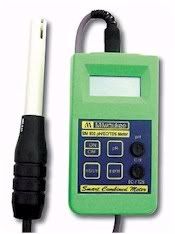
Conductivity is a measure of the rate at which a small electric current flowsthrough a solution. When the concentration of nutrients is greater, thecurrent will flow faster. When the concentration of the nutrients is lower,the current will flow slower. You can measure your nutrient solution to determine how strong or weak itis with an EC (electrical conductivity) or TDS (total dissolved solids) meter.An EC meter usually shows the reading in either micromhs per centimeter (uMho/cm) or microsiemens per centimeter (uS/cm). 1.0 uMho/cm isequivalent to 1.0 uS/cm. A TDS meter usually shows the reading in milli-grams per liter(mg/l) or parts per million (ppm).
EC is generally measured at 77 F (25 C). If the temperature of the solution is raised, the EC will read higher, even though no nutrients have been added. If the temperature drops below 77 F (25 C), the EC will decrease.Therefore, it is important to always measure your EC at a consistent temperature of 77 F (25 C). Some EC and TDS meters compensate for varying temperatures. Another measurement in conductivity is CF (conductivity factor) which is expressed on a scale of I -100. Pure water containing no nutrients is rated at 0 and maximum strength nutrients would rate 100.
In low light conditions (winter), a hydroponic grower should increase the concentration of nutrients in solution in a hydroponic garden. In high light conditions (summer), a hydroponic grower should decrease the concentration of nutrients in solution in a hydroponic garden.
Labels: CF (conductivity factor), EC meter, light conditions, Measuring Conductivity
Posted by Thanate 0 comments Links to this post